
Understanding the difference between a Monstera node and an axillary bud makes propagation and reversion pruning much easier. They are related, but they are not the same thing.
Quick answer: the node is the section of stem where a leaf and other structures attach. The axillary bud is the small growth point associated with that node that can activate and produce a new vine. For a variegated Monstera cutting, you want a healthy node with a viable bud and, ideally, visible variegation running through the stem near that growth point.
Monstera node vs axillary bud: the node is the section of stem where structures attach, while the axillary bud is the growth point that can activate into a new shoot.
What Is a Monstera Node?
A node is a structural section of the main stem. On a mature Monstera vine, it is usually the area where you can find several useful landmarks:
- a leaf petiole attaching to the stem;
- an aerial root or aerial-root nub;
- a small axillary bud or dormant growth point;
- the internode extending to the next node.
The node contains the tissue needed to support future stem growth. This is why a leaf-only cutting is not enough for propagation: the leaf can remain alive for a time, but without a viable node it cannot produce a new Monstera vine.
For the complete rooting process, see How to Propagate Variegated Monstera.
What Is an Axillary Bud?
The axillary bud is the small growth point that sits at or near the node, often close to where the petiole meets the main stem.
On an uncut climbing Monstera, the active growing tip usually remains dominant while lower axillary buds stay dormant. If the top is removed, one of those lower buds may activate and become the new vine.
This matters for two common situations:
- Propagation: the cutting needs a viable growth point so it can produce a new shoot.
- Reversion pruning: you want the new vine to emerge from a bud that still has access to variegated tissue.
How to Find the Axillary Bud on a Monstera
Look closely at the node rather than at the leaf blade. The bud can appear as a small raised oval, bump, eye or slightly different patch of tissue near the petiole attachment.
On older stems it may be easier to see. On very young growth it can be small and easy to confuse with other stem texture.
Aerial roots are not axillary buds. An aerial root may emerge from the same general node area, but its job is rooting and support, not producing the next vine.
Node, Aerial Root and Axillary Bud: Quick Comparison
| Structure | What it is | Main role |
|---|---|---|
| Node | Section of the stem | Holds the structures needed for future growth |
| Axillary bud | Dormant growth point at the node | Can activate and produce a new vine |
| Aerial root | Root structure emerging from the node area | Anchoring and water/nutrient uptake |
| Petiole | Stalk connecting leaf blade to stem | Supports the existing leaf |
The easiest mistake is to buy or cut a beautiful leaf with an aerial root but no viable node. An aerial root by itself does not replace the growth point.
How Much Stem Should a Cutting Include?
A cutting should include enough healthy stem around the node that you can handle and root it without damaging the bud.
Avoid cutting directly through the node. Leave a small margin of stem on both sides when possible, especially if the cutting is valuable or highly variegated.
Use a sharp sanitized tool and inspect the cut surface. Firm tissue is a better sign than soft, dark or foul-smelling stem material.
How to Read Variegation on the Node
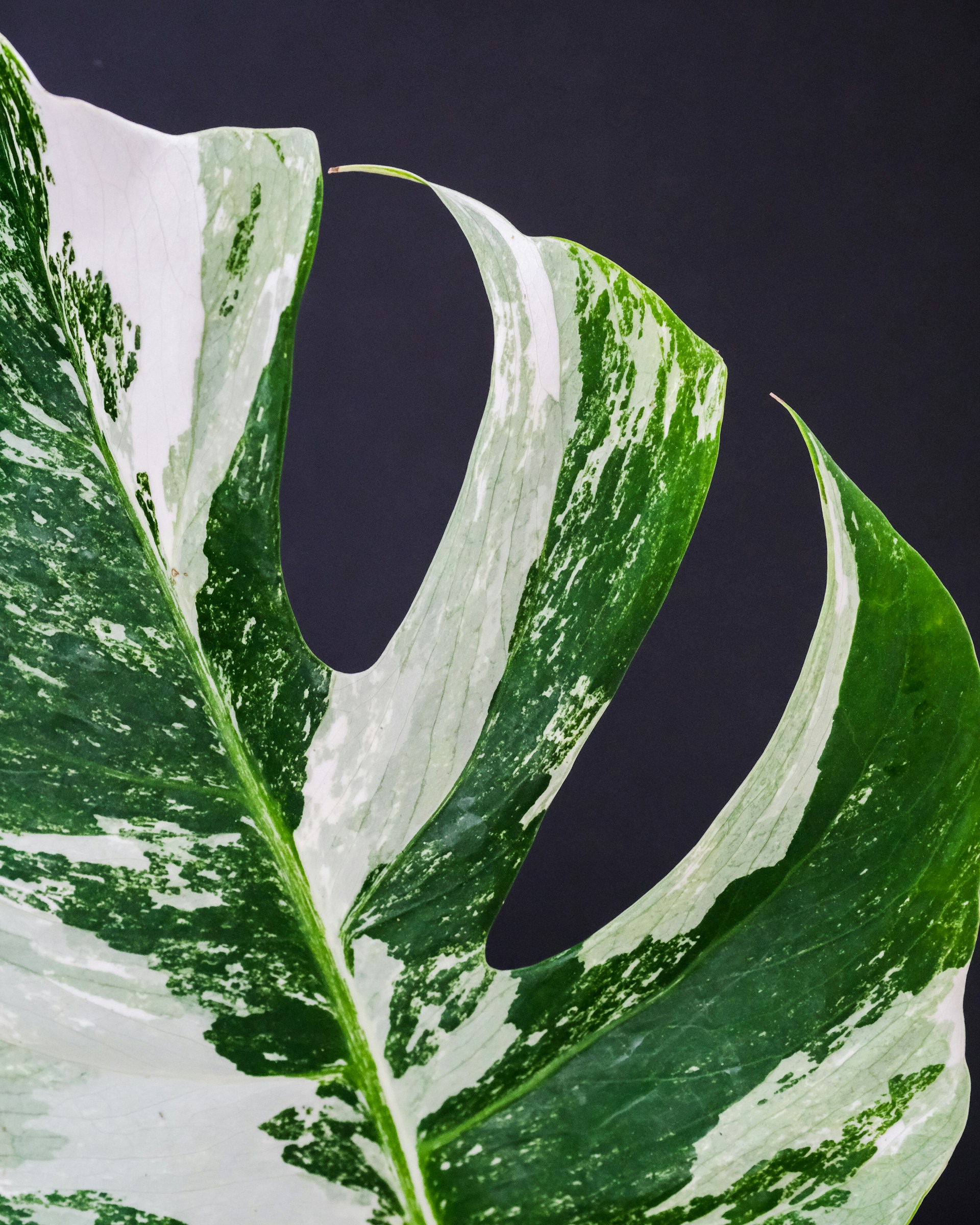
For a variegated Monstera, the leaf pattern is only part of the picture. Before making a cutting, inspect the stem striping around the node and axillary bud.
A node where cream or white variegation visibly crosses the area of the bud can be a better candidate for mixed new growth than a bud sitting entirely in green stem tissue.
However, this is not a guarantee. The internal cell pattern of the growth point cannot be read perfectly from the outside.
That distinction is especially important when trying to correct a reverting Monstera. The detailed guide Variegated Monstera Turning Green? How to Stop Reversion explains how to trace the vine back to a more promising node.
If you have already confirmed reversion and the remaining question is where to make the corrective cut, use Where to Cut a Reverting Variegated Monstera. It focuses on choosing the lower node to keep and protecting its axillary bud during the cut.
Which Node Should You Choose for a Variegated Cutting?
Prefer a node that combines several positive signs:
- firm healthy stem tissue;
- a visible viable axillary bud;
- some green tissue for photosynthetic support;
- visible variegation running through or near the bud area;
- no soft, black or collapsing tissue;
- enough stem to cut safely without injuring the node.
Do not choose purely by the amount of white on the leaf. A highly variegated leaf attached to a mostly green bud can still produce greener new growth, while a more balanced leaf may sit above a strongly striped node.
Can a Fully Green Node Become Variegated Again?
If the active growth point itself is fully green, more light or fertilizer cannot manufacture variegated tissue inside it.
That is why corrective pruning for reversion focuses on moving the plant’s active growth back to a lower node that still intersects variegated tissue.
Bright light can support the plant’s energy needs, but it does not rewrite the genetic makeup of a fully green bud.
Can a Leaf Without a Node Root?
A leaf and petiole may sometimes remain alive or even form roots, depending on the tissue included, but without a viable Monstera node and growth point it cannot develop into a new vine.
For buyers, this is one of the most important checks before purchasing a single-node cutting. Do not pay a premium simply because the leaf looks highly variegated. Confirm that the stem section includes a real node.
What Is a Wet Stick?
A “wet stick” is a stem segment with a viable node but little or no leaf attached. It can produce roots and a new shoot if the node remains healthy and the bud activates.
Because there is little leaf area to support photosynthesis, wet-stick propagation depends heavily on the stored energy in the stem and on stable moisture, warmth and cleanliness.
Do not bury the entire node deeply in a dense mix. An airy propagation medium helps keep the tissue moist without excluding oxygen.
What Happens After You Cut the Top?
Removing the active tip reduces its dominance over lower buds. One of the remaining axillary buds can then activate and become the new leader.
Activation is not always immediate. The plant may spend time stabilizing roots and redirecting resources before visible new growth appears.
If you are cutting specifically to stop reversion, monitor the new stem, not just the first new leaf. The stem pattern gives useful information about whether the replacement vine is carrying variegated tissue.
Potting a Rooted Node
Once the cutting has developed several healthy roots, move it into a small pot with an airy substrate rather than a large volume of dense soil.
The Best Soil Mix for Variegated Monstera guide gives a 40/30/20/10 starting recipe. After potting, use moisture and pot weight rather than a rigid calendar; see How Often to Water Variegated Monstera.
Frequently Asked Questions
Is the growth point the same as the axillary bud?
In a single-node cutting, people often use the terms loosely. The axillary bud is the dormant growth point associated with the node that can activate into a new shoot. The active tip at the end of an established vine is a different, already-growing meristem.
Can I cut directly through a node?
Avoid it. Cutting through the node can damage the bud and the tissue needed for future growth. Leave healthy stem around the node when possible.
Does an aerial root mean the cutting has a node?
An aerial root usually emerges from a node area, but do not rely on the root alone. Inspect the stem for the node and viable growth point before buying or cutting.
Does more stem variegation always mean a better cutting?
Not necessarily. The cutting still needs enough green tissue to support itself, and visible striping cannot guarantee the exact pattern of the next shoot. Aim for a healthy, balanced node rather than chasing the whitest possible stem.
Continue the Variegated Monstera Care Series
- How to Propagate Variegated Monstera — root the node in water, sphagnum or another airy medium.
- Variegated Monstera Turning Green? How to Stop Reversion — choose the right lower bud before corrective pruning.
- Best Soil Mix for Variegated Monstera — pot a rooted cutting without suffocating the roots.
- How Often to Water Variegated Monstera — manage the root zone after potting.