If you are trying to choose the best moss pole for a Monstera, do not start with price or appearance. Start with what you want the support to do.
Quick answer: choose sphagnum or a refillable modular pole if you want aerial roots to grow into a moist support and you are willing to maintain it. Choose coir if you mainly want simple, lower-maintenance support. Choose a wooden plank or rigid stake if stability matters more than moisture. For a fast-growing Monstera, an extendable system is usually easier to live with than a fixed-height decorative pole.
Best Moss Pole for Monstera: Choose in 20 Seconds
| Your priority | Best starting choice | Why |
|---|---|---|
| Aerial roots growing into the support | Sphagnum-filled pole | Moist moss can give aerial roots a medium to enter |
| Lowest maintenance | Coir pole or dry stake | No separate moss-watering routine |
| Easy future extension | Modular plastic moss pole | Sections can be added as the vine climbs |
| Heavy mature Monstera | Wooden plank or rigid support | Stability is the main advantage |
| Variegated Monstera in a controlled setup | Extendable sphagnum or modular pole | Combines root attachment with room to keep climbing |
There is no single best pole for every plant. The best choice depends on root attachment, maintenance, stability and how tall the plant is likely to become.
Sphagnum vs Coir vs Plastic: The Real Trade-Off
Choose sphagnum if root attachment matters most
A true sphagnum pole contains long-fiber moss inside a mesh or structured shell. When kept lightly moist, aerial roots may enter the pole instead of simply wrapping around it.
This is the most useful choice when you want the pole to behave like an extension of the rooting environment, not just as a stake.
The trade-off is maintenance: the pole needs moisture without staying saturated or creating an airless wet zone around the stem and pot.
Choose coir if simplicity matters most
Coir poles are usually simpler and drier. They give the vine a rough surface to lean against or attach to, but they do not behave like a moist sphagnum column.
For growers who want vertical support without another thing to water, coir can be the more practical choice even if it offers less active root penetration.
Choose modular plastic if future height matters most
Refillable modular poles can be useful for fast-growing Monstera because sections can be added as the vine gets taller.
They make the most sense when you expect the plant to outgrow a fixed pole quickly and want a support you can extend without rebuilding the entire setup.
Choose wood if stability matters most
A plank or rigid stake is often better than a lightweight decorative pole for a large, heavy vine. It does not provide a moist rooting surface, but it can be much more stable.
Best Moss Pole Type by Use Case
| Type | Best for | Main advantage | Main drawback |
|---|---|---|---|
| Sphagnum-filled pole | Active aerial-root attachment | Can stay moist and encourage roots into the pole | Requires watering and maintenance |
| Coir pole | Simple support | Low maintenance and widely available | Holds less moisture than sphagnum |
| Plastic moss pole | Modular setups | Easy to extend and refill | Appearance and rigidity vary by design |
| Wooden plank/stake | Large mature vines | Very stable and simple | Does not provide a moist rooting surface |
What I Would Choose for a Variegated Monstera
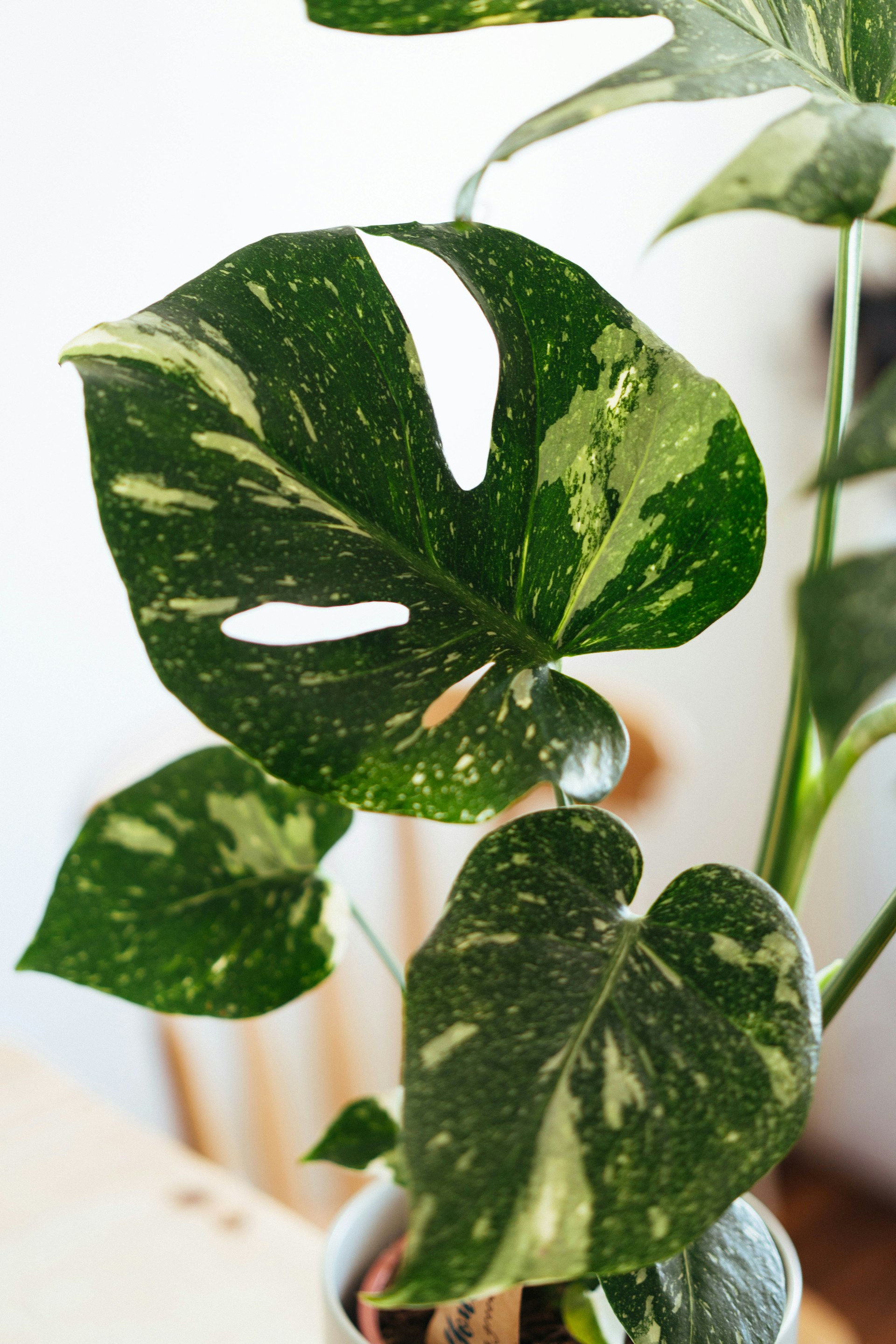
For a healthy Monstera Albo or Thai Constellation that is actively climbing, an extendable pole with enough rigidity for the plant’s weight is usually the most flexible setup.
Use sphagnum inside the pole if you specifically want aerial roots to grow into a moist medium and you are prepared to maintain that moisture. If you know you will not keep the moss consistently but safely damp, a dry support is often a better real-world choice than a sphagnum pole that is alternately bone-dry and saturated.
The pole should also extend above the current growth point. Buying a support that the plant will outgrow after one or two leaves usually creates more root disturbance later.
How Tall Should the Pole Be?
Do not size the support only for the plant today. Leave room above the active growth point so you are not replacing the pole after one or two new leaves.
For larger plants, an extendable system is easier to manage than repeatedly pulling the root ball apart to install a new support.
How Thick Should the Pole Be?
The pole needs enough rigidity to resist the weight of the vine. Thin decorative poles can flex under a mature Monstera.
Match thickness to:
- plant height;
- leaf size;
- pot diameter;
- expected growth over the next several months.
Pot Stability Matters More Than the Pole Alone
A tall support in a tiny lightweight pot can tip over even if the pole itself is strong. Use a pot with enough weight and root room to anchor the support without oversizing the container excessively.
See Best Pots for Variegated Monstera: Size, Material & Drainage for the pot side of the setup.
Where to Position the Pole
Place the support behind the main stem so the nodes and aerial roots face it naturally. Avoid forcing the vine into a sharp bend.
Use soft plant ties with enough slack to avoid cutting into the stem. Attach the stem, not the leaf petioles, because petioles need freedom to orient the leaves toward light.
Moss Pole and Light Work Together
A support does not compensate for weak light. If internodes are stretching and leaves are becoming smaller, check the light environment as well as the support.
Read Best Grow Lights for Rare Houseplants and How Much Light Do Rare Aroids Need?.
Buying Checklist
Before buying a moss pole, check:
- Can it support the plant’s current weight?
- Can it be extended later?
- Will it fit the current pot without destabilizing the root ball?
- Do you want a moist rooting surface or only physical support?
- Can you realistically maintain a sphagnum pole without keeping it saturated?
- Are ties or mounting points included, and are they gentle on the stem?
If you cannot answer #4 and #5, do not automatically buy sphagnum just because it is marketed as the premium option. The best pole is the one that matches the way you actually care for the plant.
Common Mistakes
- buying a pole that is already shorter than the vine;
- attaching leaf petioles tightly to the support;
- installing a tall pole in a pot too light to stabilize it;
- keeping sphagnum permanently saturated;
- replacing supports too frequently and disturbing the roots;
- expecting a moss pole to fix low light or root problems.
Frequently Asked Questions
Is sphagnum better than coir for Monstera?
Sphagnum is better when you want aerial roots to enter a moist medium. Coir is better when you want simpler, lower-maintenance structural support. The better choice depends on whether root attachment or ease of care matters more to you.
Can I add a moss pole after the Monstera is already large?
Yes, but installation is easier when the root system is not extremely crowded. Work carefully to avoid major root damage and use a support rigid enough for the existing vine.
Should the moss pole stay wet all the time?
No. If you use sphagnum, aim for appropriate moisture rather than saturation and maintain airflow around the plant.
Is a cheap moss pole good enough?
It can be, if it is tall enough, rigid enough and matches your maintenance goal. A cheap sturdy support can be more useful than an expensive decorative pole that bends, cannot be extended or is difficult to keep at the right moisture level.
Related Rare Plant Buying Guides
- Best Rare Plant Supplies
- Best Pots for Variegated Monstera
- Best Grow Lights for Rare Houseplants
- Best Soil Mix for Variegated Monstera
A good moss pole is less about decoration and more about choosing the right combination of root attachment, maintenance, stability and future height.